About me
I am Soshi Kakio, a second-year M.Sc. student at The University of Osaka,
Japan, and a specially appointed researcher at SANKEN (The Institute of
Scientific and Industrial Research at The University of Osaka).
I am fortunate to be advised by Prof. Yasushi Sakurai and Prof. Yasuko Matsubara at SANKEN.
My research mainly focuses on data stream mining and bayesian tensor decomposition [C1].
I received my B.Sc. degrees from The University of Osaka advised by Prof. Yasushi Sakurai in March 2024.
Download my CV here.
Education
-
High School Diploma
- General Course
- Yoka High School
- Hyogo, Japan
-
–
-
Bachelor
- Department of Electronic and Information Engineering, School of Engineering
- The University of Osaka
- Osaka, Japan
-
–
-
Master
- Department of Information Systems Engineering, Graduate School of Information Science and Technology
- The University of Osaka
- Osaka, Japan
-
–
-
Ph.D
- Department of Information Systems Engineering, Graduate School of Information Science and Technology
- The University of Osaka
- Osaka, Japan
-
–
Experiences
- Digital Technology Engineer
- Osaka, Japan
-
– - Specially Appointed Researcher
- Osaka, Japan
-
–
Crev
SANKEN, The University of Osaka
Publications
-
[C1] Multi-Aspect Mining and Anomaly Detection for Heterogeneous Tensor Streams
- Authors
Soshi Kakio , Yasuko Matsubara , Ren Fujiwara , Yasushi Sakurai - Conference
- The ACM Web Conference 2026 (WWW '26)
- AcceptRate
- 20.1% (676/3370)
- Links
- Keywords
- BayesianAnomaly detectionGaussian process
- Abstract
-
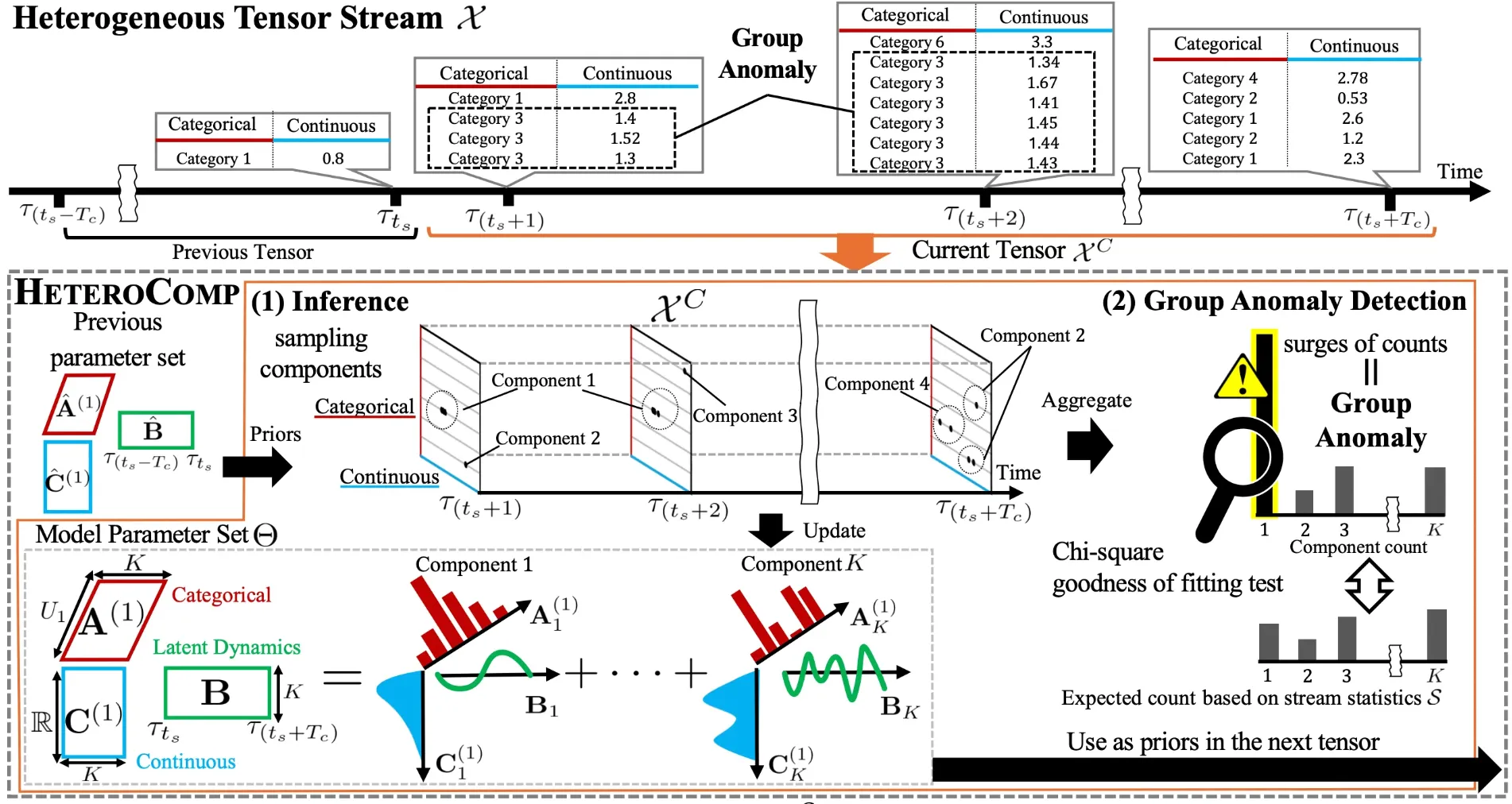
detail Analysis and anomaly detection in event tensor streams consisting of timestamps and multiple attributes —such as communication logs(time, IP address, packet length)—are essential tasks in data mining. While existing tensor decomposition and anomaly detection methods provide useful insights, they face the following two limitations. (i) They cannot handle heterogeneous tensor streams, which comprises both categorical attributes(e.g., IP address) and continuous attributes(e.g., packet length).They typically require either discretizing continuous attributes or treating categorical attributes as continuous, both of which distort the underlying statistical properties of the data.Furthermore, incorrect assumptions about the distribution family of continuous attributes often degrade the model’s performance. (ii) They discretize timestamps, failing to track the temporal dynamics of streams(e.g., trends, abnormal events), which makes them ineffective for detecting anomalies at the group level, referred to as 'group anomalies' (e.g, DoS attacks). To address these challenges, we propose HeteroComp, a method for continuously summarizing heterogeneous tensor streams into 'components' representing latent groups in each attribute and their temporal dynamics, and detecting group anomalies. Our method employs Gaussian process priors to model unknown distributions of continuous attributes, and temporal dynamics, which directly estimate probability densities from data.Extracted components give concise but effective summarization, enabling accurate group anomaly detection. Extensive experiments on real datasets demonstrate that HeteroComp outperforms the state-of-the-art algorithms for group anomaly detection accuracy, and its computational time does not depend on the data stream length.
- Illustration